
 PhD Student at the Georgia Institute of Technology
My name is Jorge Quesada. I am a PhD candidate in the School of Electrical and Computer Engineering at the Georgia Institute of Technology. I work in the OLIVES Lab with Professor Ghassan AlRegib, and I am a Computational Neural Engineering Training Program (CNTP) Scholar. I expect to graduate in Fall 2026.
My research focuses on self-supervised representation learning for scientific imaging. I study what self-supervised models actually learn, how choices like training scale shape their representations, and why that knowledge sometimes breaks down when models are transferred to new tasks and domains. My current work uses these insights to make pretraining and fine-tuning more reliable under distribution shift. I have also built large-scale benchmarks for neuroimaging and geoscience. In other projects, I explored human-in-the-loop systems, such as uncertainty-aware annotations that capture labeler expertise and prompting strategies for the Segment Anything Model.
In Summer 2026, I was an AI/ML Research Intern at Pfizer, where I built an automated imaging pipeline that computes clinical biomarkers from patient photos for a vitiligo clinical trial. I have also co-led the design of Georgia Tech's first graduate course on Generative and Geometric Deep Learning, which is now a recurring offering. Before my PhD, I worked on sparse representations, inverse problems, and optimization at PUCP in Peru and at Los Alamos National Laboratory.
I'm broadly motivated by questions at the intersection of natural and artificial intelligence: how brains and machines perceive, learn, and generalize.
I am currently on the job market for research scientist, research engineer, and applied scientist roles starting after graduation, and I'm open to relocation. Feel free to reach out!
Warning
Problem: The current name of your GitHub Pages repository ("Solution: Please consider renaming the repository to "
http://".
However, if the current repository name is intended, you can ignore this message by removing "{% include widgets/debug_repo_name.html %}" in index.html.
Action required
Problem: The current root path of this site is "baseurl ("_config.yml.
Solution: Please set the
baseurl in _config.yml to "Education
-
Georgia Institute of TechnologyDepartment of Electrical and Computer Engineering
Ph.D. Student in Machine LearningAug 2021 - present -
 Pontifical Catholic University of PeruM.S.. in Signal Processinggraduation 2018
 -
Pontifical Catholic University of PeruB.S. in Electrical Engineeringgraduation 2015
Experience
-
Georgia Institute of TechnologyGraduate Research AssistantAug 2021 - present
-
 PfizerAI/ML Research InternMay 2026 - Aug 2026
 -
 SentinelComputer Vision Data ScientistJul 2020 - Dec 2020
 -
Pontifical Catholic University of PeruGraduate Researcher and LecturerMar 2016 - Jun 2020
-
 Los Alamos National LaboratoryResearch InternJan 2017 - Apr 2017
 -
 Jicamarca Radio ObservatoryResearch AssistantJan 2015 - Apr 2015
Teaching
-
Introduction to Signal Processing ECE 2026Teaching FellowSpring 2026
-
Generative and Geometric Deep Learning ECE 8803Course Developer and Graduate Teaching AssistantFall 2023
-
Fundamentals of Machine Learning ECE 4252/8803Graduate Teaching AssistantSpring 2024
-
Senior Analog Laboratory ECE 4043Graduate Teaching AssistantSpring/Summer 2023
-
Digital Signal ProcessingMain InstructorSpring/Fall 2019
Honors & Awards
-
Cadence Diversity in Technology Scholarship Recipient2023
-
Computational Neural Engineering Training Program (CNTP) Scholar2021
-
ICASSP 2018 Student Travel Grant2018
-
Marco Polo Scholarship2016
-
ICASSP 2016 Student Travel Grant2016
Selected Publications (view all )
Scale-Aware Self-Supervised Learning for Segmentation of Small and Sparse Structures
Jorge Quesada, Ghassan AlRegib
International Conference on Acoustics, Speech, and Signal Processing (ICASSP) 2026
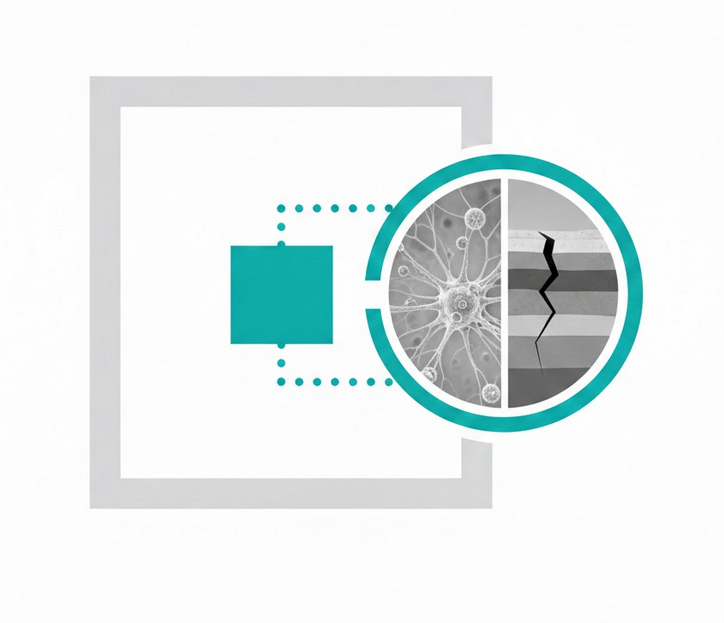
We propose a scale-aware SSL strategy that zooms in on small-window crops during pretraining to better capture fine-grained patterns. This approach aligns representation learning with the intrinsic scale of sparse structures, significantly improving the segmentation of seismic faults and cellular targets.
Scale-Aware Self-Supervised Learning for Segmentation of Small and Sparse Structures
Jorge Quesada, Ghassan AlRegib
International Conference on Acoustics, Speech, and Signal Processing (ICASSP) 2026
We propose a scale-aware SSL strategy that zooms in on small-window crops during pretraining to better capture fine-grained patterns. This approach aligns representation learning with the intrinsic scale of sparse structures, significantly improving the segmentation of seismic faults and cellular targets.
A Large-scale Benchmark on Geological Fault Delineation Models: Domain Shift, Training Dynamics, Generalizability, Evaluation and Inferential Behavior
Jorge Quesada, Chen Zhou, Prithwijit Chowdhury, Mohammad Alotaibi, Ahmad Mustafa, Yusuf Kumakov, Mohit Prabhushankar, Ghassan AlRegib
IEEE Access 2025
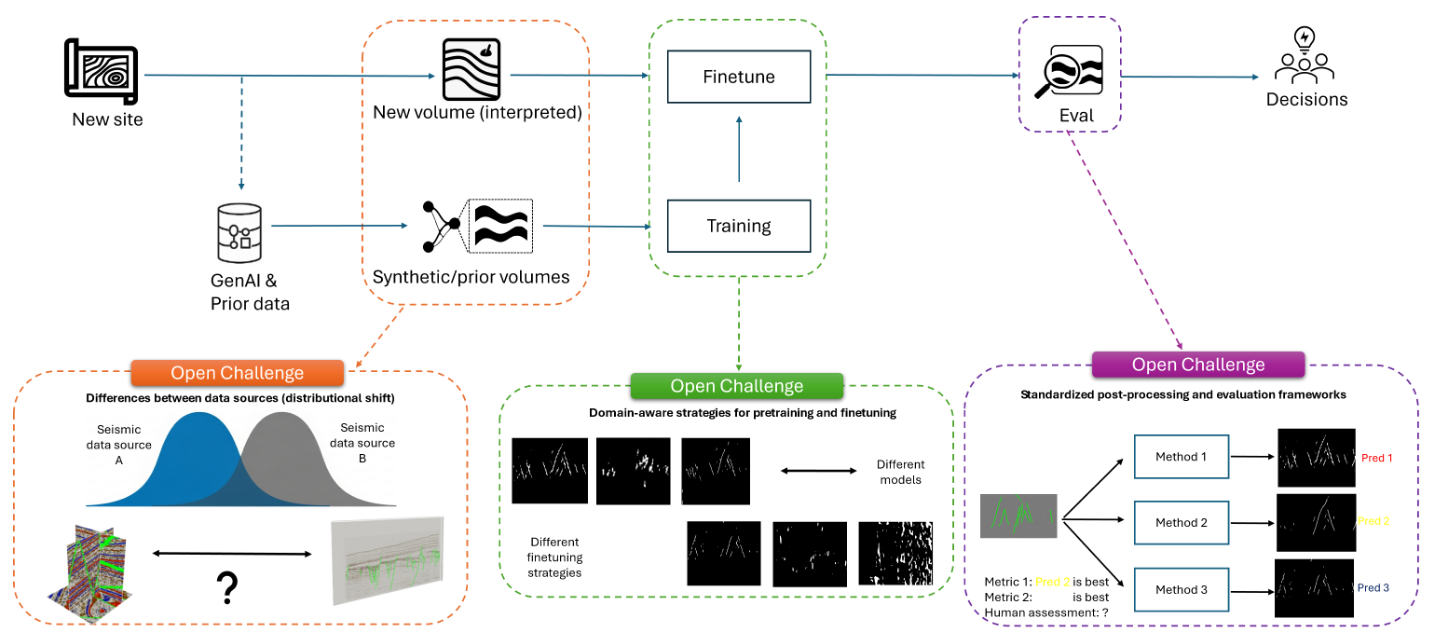
We present the first large-scale benchmarking study for geological fault delineation. The benchmark evaluates over 200 model–dataset–strategy combinations under varying domain shift conditions, providing new insights into generalizability, training dynamics, and evaluation practices in seismic interpretation.
A Large-scale Benchmark on Geological Fault Delineation Models: Domain Shift, Training Dynamics, Generalizability, Evaluation and Inferential Behavior
Jorge Quesada, Chen Zhou, Prithwijit Chowdhury, Mohammad Alotaibi, Ahmad Mustafa, Yusuf Kumakov, Mohit Prabhushankar, Ghassan AlRegib
IEEE Access 2025
We present the first large-scale benchmarking study for geological fault delineation. The benchmark evaluates over 200 model–dataset–strategy combinations under varying domain shift conditions, providing new insights into generalizability, training dynamics, and evaluation practices in seismic interpretation.
Benchmarking Human and Automated Prompting in the Segment Anything Model
Jorge Quesada*, Zoe Fowler*, Mohammad Alotaibi, Mohit Prabhushankar, Ghassan AlRegib (* equal contribution)
IEEE International Conference on Big Data 2024
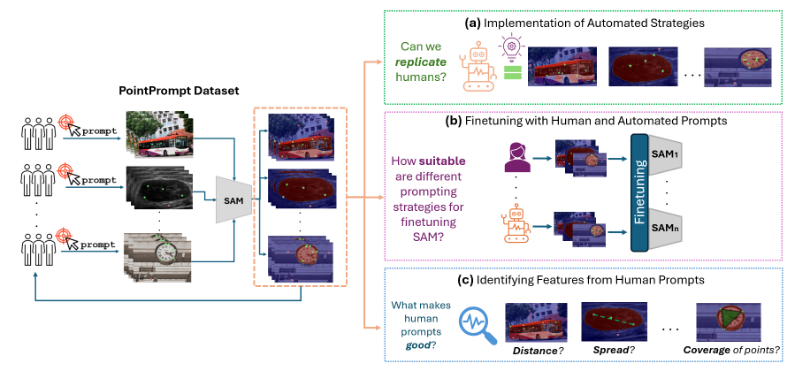
We compare human-driven and automated prompting strategies in the Segment Anything Model (SAM). Through large-scale benchmarking, we identify prompting patterns that maximize segmentation accuracy across diverse visual domains.
Benchmarking Human and Automated Prompting in the Segment Anything Model
Jorge Quesada*, Zoe Fowler*, Mohammad Alotaibi, Mohit Prabhushankar, Ghassan AlRegib (* equal contribution)
IEEE International Conference on Big Data 2024
We compare human-driven and automated prompting strategies in the Segment Anything Model (SAM). Through large-scale benchmarking, we identify prompting patterns that maximize segmentation accuracy across diverse visual domains.
MTNeuro: A Benchmark for Evaluating Representations of Brain Structure Across Multiple Levels of Abstraction
Jorge Quesada, Lakshmi Sathidevi, Ran Liu, Nauman Ahad, Joy M. Jackson, Mehdi Azabou, Christopher Liding, Matthew Jin, Carolina Urzay, William Gray-Roncal, Erik Johnson, Eva Dyer
NeurIPS Datasets and Benchmarks Track 2022
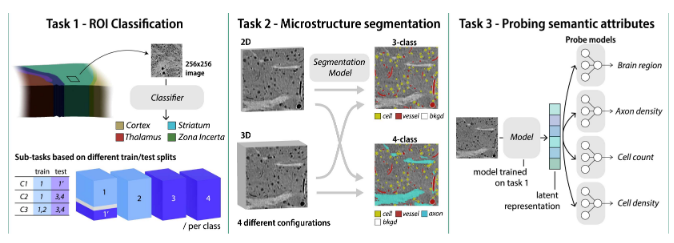
We introduce MTNeuro, a multi-task neuroimaging benchmark built on volumetric, micrometer-resolution X-ray microtomography of mouse thalamocortical regions. The benchmark spans diverse prediction tasks—including brain-region classification and microstructure segmentation—and offers insights into the representation capabilities of supervised and self-supervised models across multiple abstraction levels.
MTNeuro: A Benchmark for Evaluating Representations of Brain Structure Across Multiple Levels of Abstraction
Jorge Quesada, Lakshmi Sathidevi, Ran Liu, Nauman Ahad, Joy M. Jackson, Mehdi Azabou, Christopher Liding, Matthew Jin, Carolina Urzay, William Gray-Roncal, Erik Johnson, Eva Dyer
NeurIPS Datasets and Benchmarks Track 2022
We introduce MTNeuro, a multi-task neuroimaging benchmark built on volumetric, micrometer-resolution X-ray microtomography of mouse thalamocortical regions. The benchmark spans diverse prediction tasks—including brain-region classification and microstructure segmentation—and offers insights into the representation capabilities of supervised and self-supervised models across multiple abstraction levels.